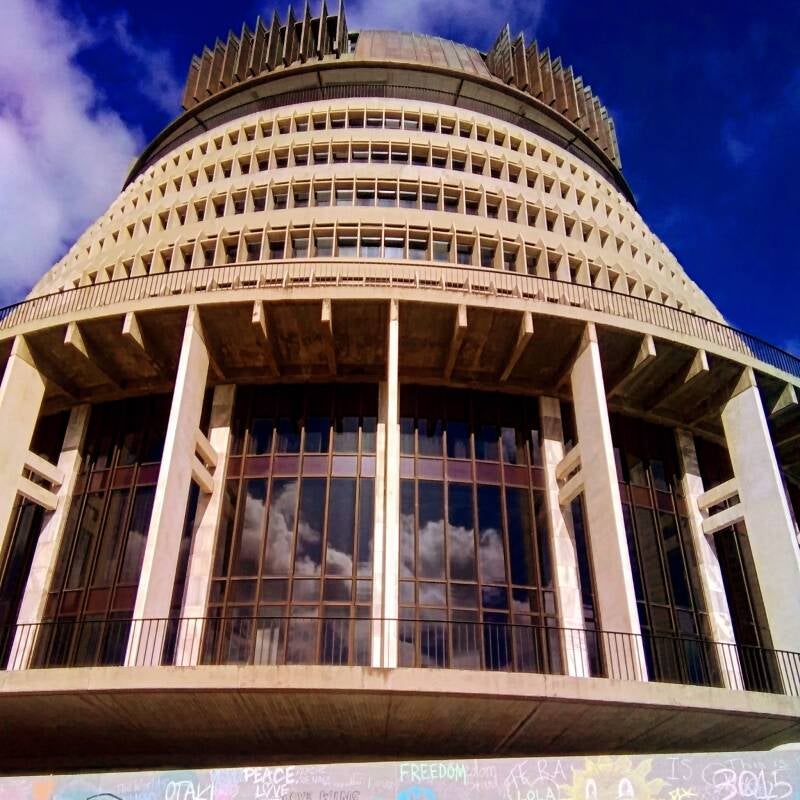
New Zealand did not invent the parliament building. It reinvented it. In 1964, when the government needed a new executive wing for a Parliament House that had stood half-finished since 1922, Scottish architect Sir Basil Spence offered not another stone hall but a round tower rising in steps — a shape he himself dubbed the Beehive, after the traditional woven skep. Ten storeys and 72 metres high, it stands at the corner of Molesworth Street and Lambton Quay in Wellington, a concrete hive where the country's government works.
The building was controversial from the day the sketches appeared, and it took its time arriving. Construction began in 1969 and was not completed until 1981; Queen Elizabeth II dedicated it in February 1977, Prime Minister Robert Muldoon formally opened it that May, and the first ministers did not move in until 1979. Inside, the top floor holds the Cabinet room, with the Prime Minister's offices on the floor below, and the rest given over to ministers' offices, the press gallery, banquet halls and Bellamy's, with four floors below ground including the National Crisis Management Centre. Its roof is 20 tonnes of hand-welted copper. At its base, the wall carries chalked messages — PEACE, FREEDOM, LOVE WINS — the building as a noticeboard as well as a workplace.
Nearly fifty years on, the hive needs work of its own. In June 2026 the Speaker, Gerry Brownlee, said the Beehive may need to be vacated for up to 18 months for repairs to its ventilation, its outside windows and other structural aspects, with the decision likely to fall to the next Parliament. The building that was once called the worst aesthetic decision in the country's history is now a Category 1 heritage place — and, for a year and a half at least, possibly an empty one.
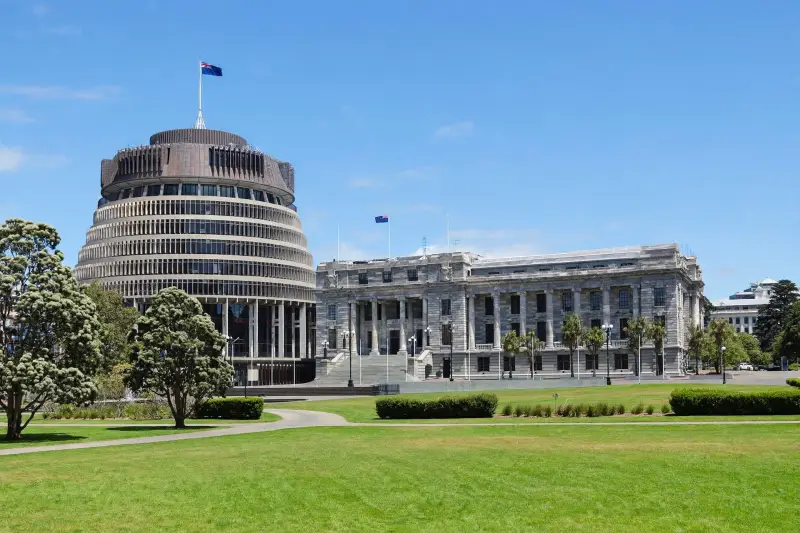
Spence's idea was a building with no front and no back. A circle treats every direction equally, and the parliamentary committee that approved his sketches in June 1965 said so in plainer terms: the circular design was functionally efficient, gave a high percentage of usable space, and had a distinctive appearance. The Government Architect, Fergus Sheppard, and the Ministry of Works carried that germ of an idea through thirteen years of drawings and construction, designing the tower to echo the rhythms, shadows and materials of the older Parliament House beside it while refusing to copy it. The metaphor did the rest of the work: a hive is not a monument, it is a working centre, a place of industry where the business of the country gets done. That is the Beehive's quiet argument — that government should look like work, not ceremony — and it is why a building mocked on arrival is now the one image of New Zealand government the world recognises.
Company: New Zealand Parliament
Website: https://www.parliament.nz
Description: New Zealand's Parliament, based in Wellington, whose Executive Wing — the Beehive — houses the Prime Minister, the Cabinet room and government ministers' offices.
Add comment
Comments