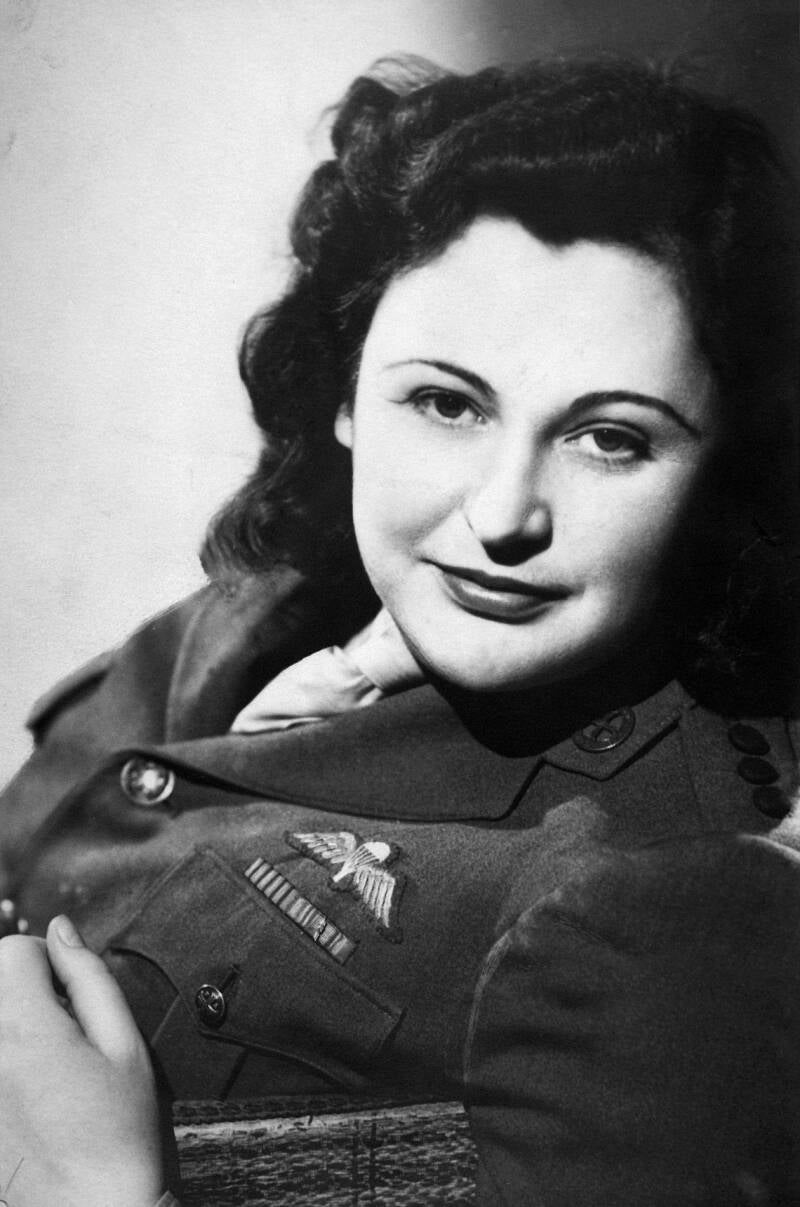
Nancy Grace Augusta Wake was born in Grass Street, Roseneath, Wellington, on 30 August 1912, and she became the most decorated Allied servicewoman of the Second World War. She was a Kiwi — part-Māori through her great-grandmother Pourewa, of Ngāti Mahanga — who was raised in Sydney from the time she was a toddler, and who always regarded herself as a New Zealander. By 1943 the Gestapo had put a price of five million francs on her head and called her the “White Mouse”, because she kept slipping their traps. A year later she parachuted back into occupied France and led some 7,000 Resistance fighters. She had reinvented herself, again and again, until she became the most wanted woman in France.
She ran away from home at 16 and worked as a nurse. With £200 from an aunt's will she travelled to New York and then London, where she trained as a journalist, and by the early 1930s she was working in Paris as a freelance correspondent. In 1933, reporting in Vienna, she interviewed Adolf Hitler and witnessed Nazi violence against Jews — the experience that turned her against Nazism. In 1939 she married French industrialist Henri Edmond Fiocca in Marseille. When Germany invaded France the following year, she joined the Resistance with him, and the life she had built in Paris became a cover for something else entirely.
From 1940 to 1942 she worked the Pat O’Leary escape line in Marseille, running a network of safe houses and guiding Allied airmen and Jewish refugees out of France. The work was so dangerous that in 1942 she was arrested in Toulouse; she was released only after the Belgian doctor Albert Guérisse — “Pat O’Leary” himself — convinced the Germans she was his mistress. Her husband was later tortured and executed by the Gestapo for refusing to divulge her whereabouts; she only learned of his death after the war. She escaped France across the Pyrenees into Spain and reached Britain in 1943, where she enlisted in the First Aid Nursing Yeomanry — the cover under which women served in the Special Operations Executive — and trained in Scotland in survival skills, codes, radio operation, night parachuting, explosives and weapons, becoming a crack shot. She was one of 39 women among the 469 agents of SOE’s French Section.
On the night of 29–30 April 1944 she parachuted into the Auvergne as part of the three-person SOE team “Freelance”, under the field codename “Hélène”, to liaise between London and the Maquis groups of the region. Her main contact was Captain Henri Tardivat’s Maquis group in the Forest of Tronçais. She led and organised Maquis forces that grew to about 7,000 fighters — arranging weapons and supply drops, radio contact with London, and sabotage of railways, depots and communications ahead of the Allied invasion of Normandy. In June 1944, some 22,000 German troops moved against her 7,000 Maquis; in her own telling, her force inflicted about 1,400 casualties while losing about 100. When her radio operator destroyed the vital codes in a German raid, she cycled about 500 kilometres through German checkpoints in 71 hours to replace them and restore the radio link to London — the exploit she herself called the most useful thing she did in the war. In her own telling, too, is the night she killed an SS sentry with her bare hands, a judo chop to the throat learned in SOE training, to stop him raising the alarm during a raid. Her comrade Captain Tardivat said of her: “She is the most feminine woman I know till the fighting starts then she is like five men.”
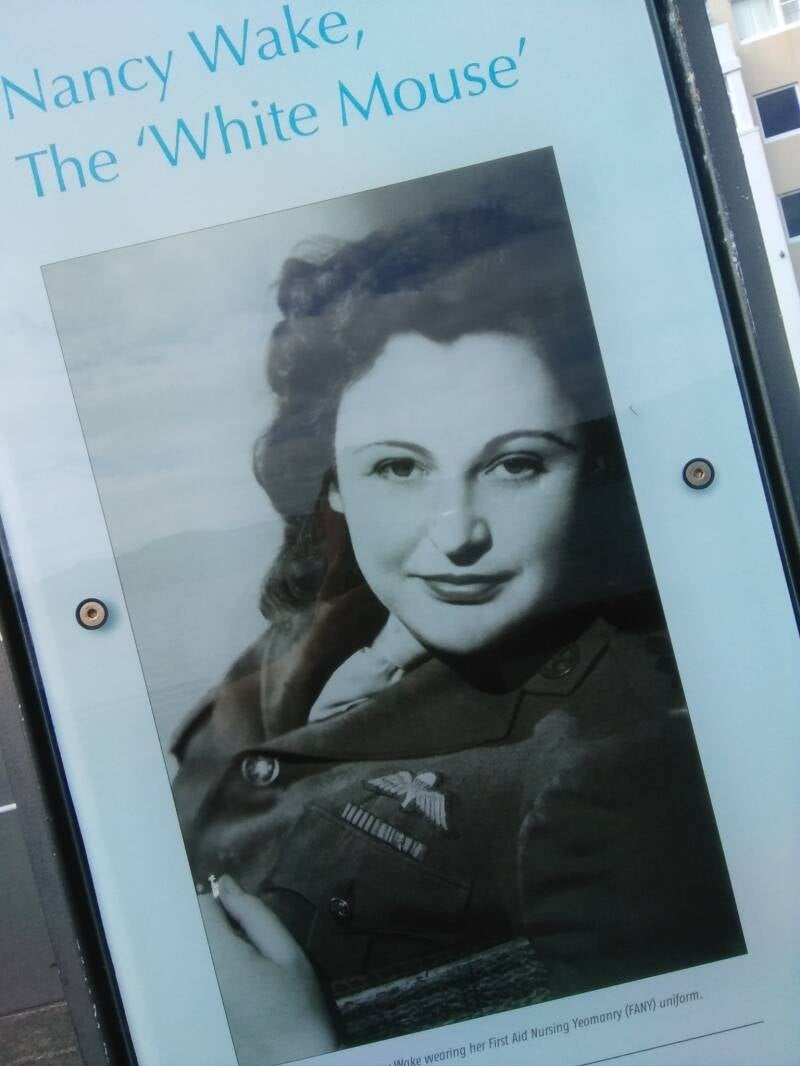
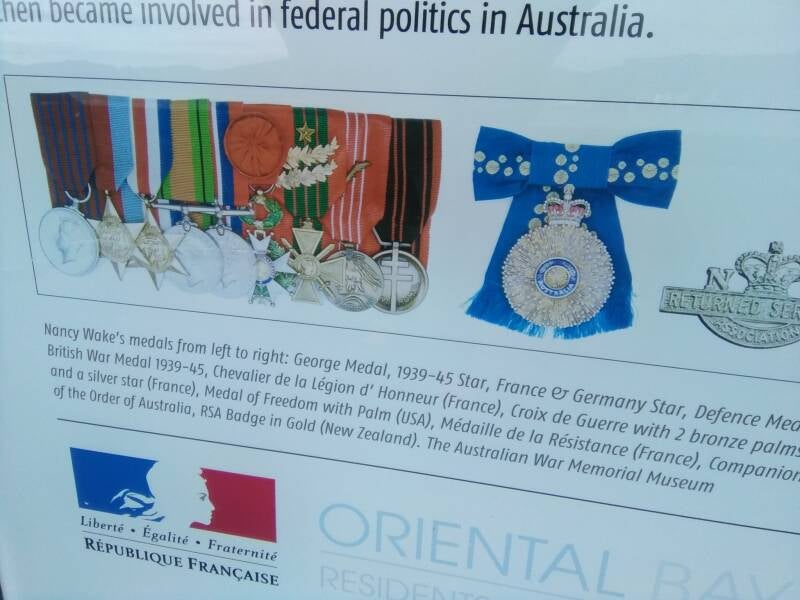
The decorations tell the rest. Britain awarded her the George Medal; the United States, the Medal of Freedom with Palm; France, the Croix de Guerre with Star and two Palms, the Médaille de la Résistance, and the Légion d’honneur — Chevalier in 1970, promoted Officier in 1988. Australia made her a Companion of the Order of Australia in 2004, her only Australian honour. New Zealand’s recognition came from the Returned and Services’ Association: the RSA Badge in Gold in 2006, the association’s highest honour. In 2010 a heritage pylon paying tribute to her was unveiled on Oriental Parade in Wellington, near her birthplace — the panel photographed for this post. After the war she returned to Australia in 1949 and stood for parliament as a Liberal candidate against Labor deputy prime minister Herbert Evatt, and lost; later she worked as an intelligence officer in the Air Ministry in London. She married RAF pilot John Forward in 1957, moved back to Britain in 2001, and died in London on 7 August 2011, aged 98. Her ashes were scattered near Verneix, in the France where she had fought, in March 2013. Her autobiography was called The White Mouse — the name the Gestapo gave her, and the name she kept.
Add comment
Comments